
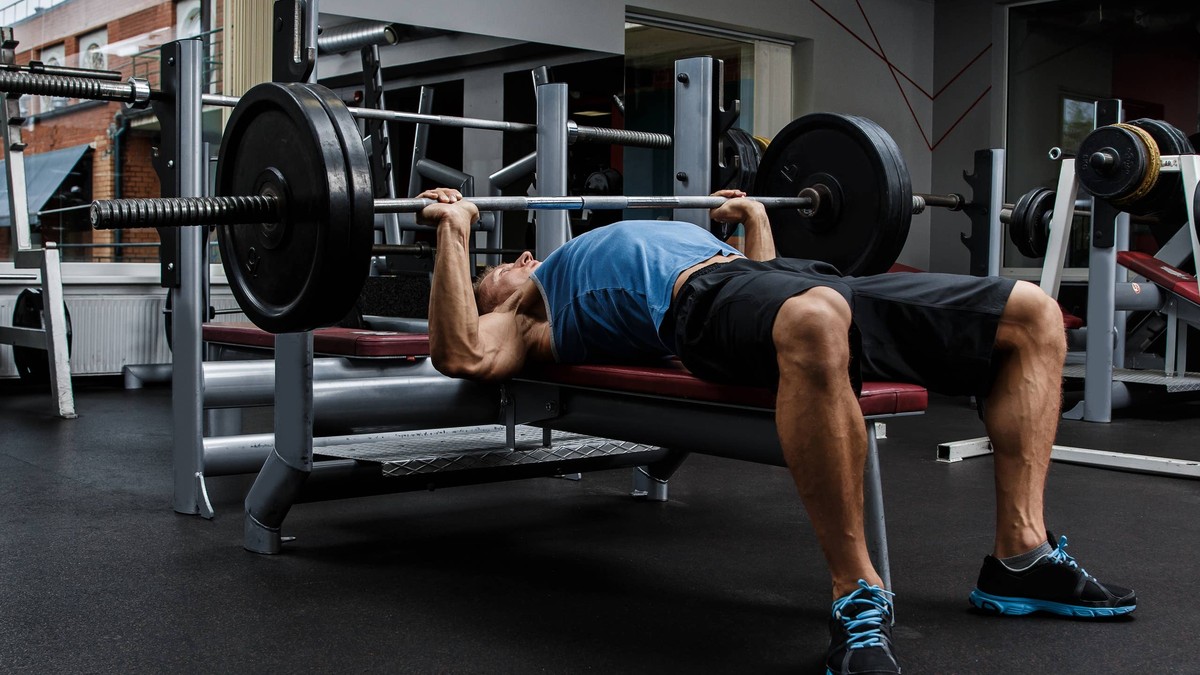
We all love Mondays at the gym.
There’s no better way to kick the Monday blues away by celebrating International Chest Day.
While the men love to bench to have chest so huge it can squash a tin can, the ladies who boast a strong bench would impress almost anyone.
People would argue which exercise is the best to develp the chest, but this isn’t really an article to fuel that particular discussion. The purpose of this article is to shed a few tips I’ve used to help improve my bench press.
I am by no means an exceptional bencher.
Due to the fact that I dislocated my shoulder a few years back (not due to lifting) I’ve never thought I’ll be able to bench heavy at all. By battling injuries and trying to keep my shoulder healthy, I know a thing or two on what works in terms of improving my bench game.
That being said, just to add some street cred to this article, I’ve gotten the help of my friend who will be revealed later to share how he improved his bench.
Mind you, he is closing in on a 180kg bench.
Without further delay, let’s jump into the meat and potatoes of this article.
1. Improve your technique
While improving technique might seem like a no-brainer, most people never really pay attention to how much technique contributes to the bench press compared to the squat and deadlift. Despite the bench being a “safer” movement and the chances of injury are much smaller if you mess up, technique is always paramount when it comes to maximising strength.
I constantly tell the people I coach that if you fail a weight, you want to fail it because of a strength issue and not a technique issue.
I’m not going to dive into a bunch of technique on how far your grip width should be or how high you should arch your back because there are tons of other great articles that does the job well. In fact, I’ve shared an article written by my good friend Greg which is probably the most comprehensive bench press resource out there and he does go through a ton of technical cues so definitely check that out.
For Greg’s article, clikc HERE
As for exceptional technique and massive weights being moved, here is Taylor Atwood (4.30 minute mark) benching 190kg in the u74kg weight class.
2. Bench More frequently
Volume is one of the primary factors when it comes to inducing adaptation, and frequency, which is the amount of session/times you perform an exercise is one way to increase total volume.
Now there are two ways one can increase volume:
a. Adding more sets, reps or both in a single session.
b. Adding more training days throughout the week.
With bodybuilding split programs being the norm that most will start out with, option A seems to be a more popular.
Head to the gym, perform 3-5 different exercises to annihilate the chest, feel sore the next day and repeat the following Monday.
I’m not exactly a fan of that approach and prefer the latter option much more. There is also evidence that suggest splitting volume over different days rather than lumping it up into a single day brings greater result in muscle mass and strength.
But for the sake of brevity, a simple reason splitting volume over different days is my preferred option is due to the fact that you’ll be performing the exercise in a state of less fatigue. Less fatigue would mean better quality reps with better technique which allows you to hone your benching prowess.
The phrase “practice doesn’t make perfect but perfect practice makes perfect” rings true when it comes to skill practice.
Just by benching more frequently and distributing training volume over 2-3 days instead of performing a “chest day” is a simple way to improve your bench. The example below could be a good place to start:
Day 1: Flat Barbell Bench Press 5×5 @ 70%
Day 2: Incline Bench Press 4 x 8 @ 65%
Day 3: Close Grip/ Flat Barbell Bench Press 6 x 3 @ 80%
” If you want to get better at shooting free throws, starting shooting more free throws. If you want to get better at benching, start benching more frequently.
This isn’t to say more is always better, moderation still plays a role. Just like how you probably wouldn’t shoot a ton of free throws till you break your wrist, you probably shouldn’t bench so often that you’ll end up with a broken upper body.”
3. Bench with intent and speed.
When it comes to lifting weights, force is a major component of strength.
Here’s a little science lesson, if the force you can generate exceed that of the load, you will be able to move that object.
However, despite powerlifting being a sport where power is almost not a requirement since you can take 5-7 seconds to grind a weight up, training with intent and speed does play a role in it. This is because Force = Mass x Acceleration so with the mass (weight on the bar) being equal, the faster you move the bar the more force you can produce.
When benching, use the speed force
To illustrate this, Westside Barbell uses something called dynamic effort days to move rougjly 40-50% of their 1RM as fast as they can. While I’m not a believer that dynamic effort days actually have carryover to maximal strength, one of the biggest powerlifting gym dedicating a day to speed shows that it has some form of importance.
In fact a study actually showed that by benching the bar as fast as possible during the concentric comapred to deliberately slowing the concentric portion of the bench b compared to the group that controlled the concentric portion.
If you don’t take science for it, here’s what a friend of mine, Max has to say:
“For the benchpress, I am a huge believer of speed. With enough speed, there’s will be no sticking points. I am not fond of doing partial range of movement aka block presses for working weakness at a certain point. That is because I believe the sticking point is a result of weakness leading up to that particular point and not weakness at that point.
With enough acceleration, you will be able to blast through that sticking point. Therefore I tend to do speed work with higher percentages. Everyone can move 60% of their 1RM fast but by constantly moving say 80% of your 1RM fast, it will have a better carryover to your comp bench. Learn to dedicate some time to working on accelerating the barbell instead of just cruising through the reps”
By the way, Max is aiming to hit a 180kg bench pretty soon, that is more than what most people would squat or probably even deadlift. So take his advice seriously if you want to improve your bench.
4. Use variation to target your weakness
There are different sticking and weak points in the bench. There are also different variations of the bench to help hit those sticking points.
Max mentioned that with the right speed, there will be no sticking points, but I believe that bench varations are particularly helpful to build strength in different parts of the lift and also to give yourself a break from the same movement all the time.
While Max isn’t a fan of partial range movement, I’ve been able to use it to help my bench improve a tad bit. Being weak at the lockout, I’ve been using floor presses and pin presses to help overcome my weak point in the lift.
This isn’t to say Max is wrong, and I’m right, neither am I wrong and Max is right.
Understand what is best for you and what works and then incorporate them into your training. I do not disagree with Max, I fully believe that you should bench with maximal intent but I still find that I slow down at the lockout, hence I incorporate movements to help that sticking point.
Through pur conversations, I know that Max also uses different variations to help hit lagging parts and the message that both of us are trying to convey here is that if you could dedicate your time to only one fix to your bench, then practice the competition bench and do it well. Accessories can come in if you have extra time and effort to spare.
That being said, here’s a list of different bench variation to hit different portions of the bench:
Off the chest: 3 count pause bench, Feet up bench
Mid point: Spoto Press, Pin Press, Board Press
Lockout: Floor Press, Close grip bench, Board Press, Pin Press
I hope this article has provided some insight on how you can improve your bench, if you have any other userful tips to help improve your bench, leave them in the comment section below.
Once again, thank you Max for the awesome tip and be sure to check his lifting progress on Instagram @Spotme_brah.
Summary:
- Perfecting technique is highly important for the bench. Do it well and it will build a solid foundation for strength gains.
- Benching more frequently allows you to practice the skill better with higher quality technique. This will help hone your bench press ability and lead to better gains in strength.
- Speed kills. It helps blast through sticking points and weaknesses in the bench. Bench with speed and intent
- Variations to help specific portions of the bench press can help. However do not neglect the main movement which is the bench press.
Tweet
Pin It
About Author

kedric
Kedric is a performance nutritionist certified through the CISSN.
He is also currently pursuing his post graduate studies in applied sports and performance nutrition.
A lover of lifting all things heavy, Kedric helps his clients improve their performance and take them to closer to their goals.
If you love ice cream & superheroes, you both might just be best buddies.
Related Posts
-
The secret is out! And how you can use nutrition to reach your goals.So here’s the big revelation. I’ve been teasing for a while now
-
Preparing for your first strength competition.As human beings, we all have some form of primal instincts. There